Recently there has been a long going post on the Extreme Programming newsgroup (http://tech.groups.yahoo.com/group/extremeprogramming/?yguid=198635929) about YAGNI. For those of you who do not know what YAGNI means please read this: http://c2.com/xp/YouArentGonnaNeedIt.html. Basically it started when some guy said that he thought XP got some things wrong and one of them was YAGNI. This of course caused lots of people to inquire/question him and out of it came several good posts. I sent some of these posts to an old colleague and he thought some people were over zealous about YAGNI. I do not doubt that people can become over zealous, no matter what you are talking about, but in this case I think the opposite is the larger problem.
Let me start with a story. At work a project came up that was for the CEO, and thus had high priority,vague requirements and an unmovable deadline! I pitched tackling this problem in an iterative fashion (Agile is becoming such a buzzword that I rarely use it in public anymore). The IT lead agreed and off we were. The team was me and a colleague (new to agile techniques and principles but liked all he had read). We couldn't dedicate much time to it as we had 2-3 other projects that had to take larger chunks of our time during any given week. We didn't have a prioritized list yet (customer was working on it with the CEO), but we did have the notion that the important thing was the landing page (the CEO doesn't like to click unless compelled). In our first working session we set up the project and hooked it up to a test page and viola we had a landing page...what next. We knew the whole point of the project was to display data and this data was coming from multiple sources (some internal, some external and some typed in) so we thought database. Then we asked, do we need it? One day yes, but not now. So we created a class and hard coded all the starting values in the code behind. This was obviously throw away code as the data must come from a database, but we got a landing page with real data in from of the team lead for direction in 2 hours spread over 2 days. He loved it and seems willing to stand up to the political forces that want us to design it all up front!
The moral I choose to draw from this story is that not doing something now even though one day, maybe even tomorrow, you will do it is a powerful tool. One reason is that software developers love to get ahead of themselves. My colleague came into my cube yesterday with a technical solution for a problem that we don't have yet. It was good that he was excited, but his (and mine) tendency is to solve the problem we sees coming because the problem we imagine is somehow more romantic than the problem right in front of us.
Our manager, not in line with the IT lead, did not feel comfortable with our approach, even though we are the two best developers in the company, because he wanted us to have solved all problems he could envision. Forget the fact that the customer wasn't even sure what he wanted...lets go solve "the problem he should be asking for" and ignore what he needs right now. It is hard to fight these forces, but knowing the technique works gives us stength to resist and carry on (I hope :-)
I am not saying that you should be blind of the future. You should always use your best judgement with the best information possible. I am just saying, and I think YAGNI is saying, be careful of your tendency to solve tomorrow's problem when today's problem can be just as challenging. In fact our last working session my colleague (the agile neophyte) re-directed our task list because I was focusing too much on back-end data issues on not enough on giving the customer value. I loved it! Our next set of tasks is still database free. It's coming...but we don't need it yet.
Saturday, May 3, 2008


Saturday, April 5, 2008
Why I Recommend One-Week Iterations
Over the years I have worked with, talked to and/or read about many agile teams. Almost none of the teams did agile software development the same way which has reinforced my belief that there is no "one way" of doing agile. One aspect of agile development I have always been drawn to is iteration length. Most teams seem to be falling in the 2-3 week range. In fact, recently a friend of mine said they were doing scrum with 3 week iterations becuase "any thing shorter caused too much overhead." I tried to point out that that isn't always the case as it depends of what overhead you are doing. I am a firm believer in minimuzing overhead as much as possible. I have always found ways to decrease or shift overhead to take less time in an iteration than previously believed possible. My favorite technique is process impedance matching.
I believe that lean thinking should be applied to software development. Given the principles of flow and value along with agile development practices it is obvious to me that the shorter the iteration the better. One of the competing forces is as the team size increases so does the overhead. To combat this I recommend capping team size to 9 (I am a slave to the magic number :-) Another consideration is the team's schedule. All the agile teams I know of work Monday to Friday and have a daily standup in the AM (9AM seems to be a popular time). People also like to forget work on weekends...some would argue it is the point of the weekend. Given these factors releasing on a Friday make the most sense to me. Monday's typically are hard... catching up on emails from people you didn't get to on Friday, remembering what it was you were doing when you left Friday...so planning meetings are best suited for Monday's. As you plan you are refreshing your memory as to the features you plan on bulding. All of this seems to point to a week long schedule of Monday mornings are planning and Friday afternoons are releasing. It's a nice package for an iteration in my opinion. I am open to shorter, but longer seems wastefull.
Many people will immediately think some version of the following: "That can't be a good idea becuase I'm not doing. If it was a good idea I would have thought of it when we decided to do >1 week iterations" or "I am sure it is >1 week here for a good reason...I just don't know exactly what that reason is." Given that I would like to convince you that my belief should be your belief (one of my many weaknesses) let me try and lay out common arguments against the one week iteration.
A1) One week iterations will have too much overhead.
I have found that the most people say this because they they they have to cram all the overhead they currently do in 3-4 weeks into one thus it is obvious to them this makes no sense. This assumption does not hold because of the lean principle of waste reduction and thus the goal is to minimize overhead. I challenge everyone to examine what overhead is actually needed in EVERY week? We already have blocked of 2 half days (Monday morning planning and Friday afternoon release & retrospective) as well as the 15 min stand up every day. Everything else should be avoided or at least minimized. If your organization requires a weekly status report and meeting. Use process impedance matching (e.g. let the team lead do it for the whole team; rotate through the team). Most all obstacles can be overcome if you use a brainstorm session with you team. If you have trouble solving a problem use the many internet sources (websites, groups, blogs...) If you seem stuck it is probably due to a lack of true teamwork (The Core has some iteresting ideas).
A2) Weekly releases are wasteful
Usually this comes from a management type who is thinking that all releases must have the business customer present (or some overhead thing like A3). If your business customer isn't engaged enough to commit to 2 half days a week then improvise and have a team member play a surrogate customer in those meetings. Different people have different skills, but hopefully one member of your team can think from a customer's point of view long enough for you to move forward. Once the customer makes time then re-validate. I am not saying it isn't ideal to have a fully committed business customer, but don't throw the baby out with the bath water.
A3) We can't do X in one week iterations
X is usually some localized practice that has evolved from a problem that wasn't solve, but is now. Like passing all releases to some QA team. If your organization is one with a separate QA team that must "sign off" on all external releases then simply use process impedance matching and send them your final release (the one that has all features needed in the time allowed) and then they test and they few if any defects (if you used proper agile development techniques) . You fix them as they find them and send them one more release when they are done (if they can manage to test in one week...doubtful if your organization hasn't embraced continuous testing..then send them one per week without needing to change your process much). Pretty simple if your team thinks about how to fit what needs to be done for organization reasons with what has to be done for agile development reasons.
I am sure there are more arguments out there that don't neatly fit into one of the above. Please comment with them. I think Tom Gilb once challenged an audience that over lunch he could figure out a way to release early then they currently do (Gilb's guidance was 2-5% of budget/schedule for each release). He got at least one free lunch out of that challenge. I am willing to take the few who read this on :-)
Monday, June 18, 2007
Why Do People Do The Things They Do?
I am currently interviewing for a new job as my current contract is coming to an end soon. One of the things I find interesting about interviewing is the different way organizations do it and how their culture comes out (or doesn't) during the interview process. The are obviously looking for a certain shape to fit a hole in the organization and they want to find out if your shape will fit (of course they never tell you much about the shape they want...then again most people do not really know what they want). Another thing that has me thinking is why the various intelligent people I meet believe the things they do about software development. One guy told me he thought agile software development was good for web development and not much else. Another told me that a PM should be able to manage any old project (from large scale software development to office moves) and it didn't really matter what experience the PM had. Like some guy who had done office moves could manage a large scale software development effort?!?
So why do these people who appear intelligent and thoughtful believe these ideas that to me seem about as silly as Galen's methods would to a modern doctor? As a student of humanity for these 40+ years I have been alive I think if has to do with the nature of human belief. If if google that term you get an various pages trying to make sense of the world's religions. Religion is just one aspect of human belief. I am talking about how do people come to "know" the things they base all of their decisions on. Lets make this personal: The last time you interviewed some one why did you recommend them or not? Ask your self why of each reason you give. What phrase/terms can you not answer why on? Maybe an example will help:
1. He seemed to know his stuff - why?
2. He said things that convinces me he could do the job - why?
3. The examples he used resonated with my own experience - why?
4. Because I think I do a good job so if he thought like me so would he - why?
5. Because I get rewarded by my boss - why?
6. Because he thinks like me - why?
7. Because I have adjusted my personality to be someone he likes - why?
8. Because I wanted to get promoted -why?
9. Because I wanted more power and money - why?
10. So I can be secure in my future - why?
11. Because that is who I am - why?
12. I DO NOT KNOW! Enough blankety blank questions already!
So my challenge to you. Analyze a decision you have made recently and see why you did it. Not the simple answer but the real reason. If may teach you something about yourself.
Saturday, April 14, 2007
Long Term Planning for Agile Projects
The other day my boss asked me about what do I think about how to do long term planning for an agile project. Of course I hve an opinion which I gladly share :-) I think agile software development makes planning much easier that traditional projects. Though the techniques are similar. The details here are for an IT environment although they can easily be varied for other software organizations. So here is my approach (beware it is looooong):
First start with a list of Features as defined by your customer that constitutes the project's scope. Next use the wide-band delphi estimation technique. The estimation team must consist of the customer(s) who requested the Features and at least 2 members of the agile team tasked with delivery (tech lead and team lead at a minimum) and at least one expert not on that team. The non-customer representation should be 5-7 in size not counting the moderator. I like to document the following for each Feature: description,assumptions, average estimate and standard deviation. Then depending on the risk deemed appropriate for the project determine the final number based on this:
A - Mean = 50% chance of actual work exceeding the estimate
B - Mean + 1 std dev = 16% chance of actual work exceeding the estimate
C - Mean + 2 std dev = 2% chance of actual work exceeding the estimate
D - Mean + 3 std dev = ~0% chance of actual work exceeding the estimate
I would never use A because I think this is gambling. I would never use D because I don't believe any estimate has that low a chance of being wrong. Of course all of this is based on statistics and we have all heard some variation on this quote:
So do you use 8 or 9 for Feature X? As I said above "depending on the risk deemed appropriate for the project ." This means that a high risk project should use the larger number. The riskier the project the safer the estimates need to be. A risky project usually has a high number of unknowns and a high degree of pressure. Unknowns makes estimation hard and pressure tends to make estimates low (and the project hard because of them). If you succumb to the pressure at the beginning of the project you are doomed.
Another pitfall can occur when the Features are too big. You should be keeps the estimates in single digits of person weeks. I doubt any estimate of week past this. What do you do when a Feature is too big? Help the customer break it into multiple Features. Repeat until all features come in as single digits. This tool is a mainstay of agile planning and will be needed for each sprint planning session so it is critical you understand how to do this. If you need help please read Mike Cohn's book "Agile Estimating and Planning" and use the abundance of experience in Yahoo Groups. I find these two to be the best in this area:
http://tech.groups.yahoo.com/group/extremeprogramming/
http://groups.yahoo.com/group/scrumdevelopment/
Next you get the customer's to rank them in priority. If there are multiple customers then you need a moderator who knows how to get multiple parties to agree and a simple technique or two to get them to put a number on each and every Feature. You will get at least one customer who says "I don't care, just get them all done" please be patience and ask them to participate in the ranking. Do not try and convince them of the importance, if they say something like this is an open forum they are pretty much not going (or probably even try) to understand in an open forum. So now you have a ranked list of Features with estimates.
At this point some of you may be wondering what unit of measure to use. I would go with person-weeks. Features should be big enough to take a week. Weeks are easy for people to grasp. Reasons not to use other units:
Now you need to add a timeline to your list of Features. We will not put dates on each Feature. Instead we will draw a line with the Y axis as Feature person-weeks and the X axis as sprints. The slope is the bur rate we expect from our team. With a team of 7 and a sprint length of one week do not expect 7 person-weeks/sprint. This presumes 100% effeciency. Remember there are planning eets, demos, doctor appointments and other non-project work. If you have historical data then use that to inform you. If you do not the 50% on task is probably a good starting point. Our fictional project has 10 features with sizes 2,5,4,4,4,7,2,5,5,2 (total 40 person weeks). That menas we should be done in the middle of sprint 12 (40/3.5 = 11.4). Remember we are using estimates for this prediction. Instead of drawing one line I would draw two - pper and lower limit, and reality should fall in betweem (give your customer the upper limit). List use a burn rate of 3 and 4 for these two lines (if you are really into numbers you can use +- some percentage..say 15?). That gives us a lower limit of 10 (40/4) and an upper limit of 14 (40/3). So tell your management 10-14 sprints and use 14 as the end date. Now the sprints can start.
There are several ways to do Agile planning within sprints. The key for me is how you break up the work. One way to break this work up can be seen here: http://www.mountaingoatsoftware.com/sprint_backlog. I recommend slicing the Feature into Feature Slices. Feature Slices are stories that slice the Feature end to end. Using slices means each story is a mini-feature so each one would be recognizable from the customer's point of view and would have distinguishable value. This allows the customer to prioritize the work in a meaningful way. The link above is developer focused and helps the team's natural inclination to silo and sub-optimize.
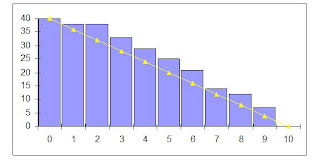
That's about all the techniques you need. The rest is presentation. I am lazy so lets do an example. Our team has 7 members as is following a one week sprint. Here is their Sprint Burndown chart (Bar height shows work left, The line represents expected burndown; used to determine estimated completion time):
First start with a list of Features as defined by your customer that constitutes the project's scope. Next use the wide-band delphi estimation technique. The estimation team must consist of the customer(s) who requested the Features and at least 2 members of the agile team tasked with delivery (tech lead and team lead at a minimum) and at least one expert not on that team. The non-customer representation should be 5-7 in size not counting the moderator. I like to document the following for each Feature: description,assumptions, average estimate and standard deviation. Then depending on the risk deemed appropriate for the project determine the final number based on this:
A - Mean = 50% chance of actual work exceeding the estimate
B - Mean + 1 std dev = 16% chance of actual work exceeding the estimate
C - Mean + 2 std dev = 2% chance of actual work exceeding the estimate
D - Mean + 3 std dev = ~0% chance of actual work exceeding the estimate
I would never use A because I think this is gambling. I would never use D because I don't believe any estimate has that low a chance of being wrong. Of course all of this is based on statistics and we have all heard some variation on this quote:
There are three kinds of lies: lies, damn lies, and statistics. --Benjamin DisraeliWe are just putting confidence levels on our estimate. What might these numbers look like in reality... An estimate team of 7 estimates Feature X to take 4,5,5,6,6,7,9. Using B you get 8 and C you get 9. Some of you might be tempted to use decimal places...please do not. I am sure there is quote out there, but here is my general rule: let the level of precision of a number be based on its accuracy. Accuracy of an estimate is always low so please don't use decimals (precision) If you don't understand, please read this explanation of the difference between precision and accuracy.
So do you use 8 or 9 for Feature X? As I said above "depending on the risk deemed appropriate for the project ." This means that a high risk project should use the larger number. The riskier the project the safer the estimates need to be. A risky project usually has a high number of unknowns and a high degree of pressure. Unknowns makes estimation hard and pressure tends to make estimates low (and the project hard because of them). If you succumb to the pressure at the beginning of the project you are doomed.
Another pitfall can occur when the Features are too big. You should be keeps the estimates in single digits of person weeks. I doubt any estimate of week past this. What do you do when a Feature is too big? Help the customer break it into multiple Features. Repeat until all features come in as single digits. This tool is a mainstay of agile planning and will be needed for each sprint planning session so it is critical you understand how to do this. If you need help please read Mike Cohn's book "Agile Estimating and Planning" and use the abundance of experience in Yahoo Groups. I find these two to be the best in this area:
http://tech.groups.yahoo.com/group/extremeprogramming/
http://groups.yahoo.com/group/scrumdevelopment/
Next you get the customer's to rank them in priority. If there are multiple customers then you need a moderator who knows how to get multiple parties to agree and a simple technique or two to get them to put a number on each and every Feature. You will get at least one customer who says "I don't care, just get them all done" please be patience and ask them to participate in the ranking. Do not try and convince them of the importance, if they say something like this is an open forum they are pretty much not going (or probably even try) to understand in an open forum. So now you have a ranked list of Features with estimates.
At this point some of you may be wondering what unit of measure to use. I would go with person-weeks. Features should be big enough to take a week. Weeks are easy for people to grasp. Reasons not to use other units:
- Points can mean different things to different people and will usually confuse/frustrate your customer
- Hours are too fine grained and too precise for accurate estimates of large chunks of work
- Months are too long for most projects. I do not trust any estimate that is months away. If your project is huge then use two levels of estimates. Start with groups of Features...I like to call them a Capability. One by one split these Capabilities into Features and use the technique here. Then roll the features up by Capability (Excel excels at this ;-) to get a complete picture.
Now you need to add a timeline to your list of Features. We will not put dates on each Feature. Instead we will draw a line with the Y axis as Feature person-weeks and the X axis as sprints. The slope is the bur rate we expect from our team. With a team of 7 and a sprint length of one week do not expect 7 person-weeks/sprint. This presumes 100% effeciency. Remember there are planning eets, demos, doctor appointments and other non-project work. If you have historical data then use that to inform you. If you do not the 50% on task is probably a good starting point. Our fictional project has 10 features with sizes 2,5,4,4,4,7,2,5,5,2 (total 40 person weeks). That menas we should be done in the middle of sprint 12 (40/3.5 = 11.4). Remember we are using estimates for this prediction. Instead of drawing one line I would draw two - pper and lower limit, and reality should fall in betweem (give your customer the upper limit). List use a burn rate of 3 and 4 for these two lines (if you are really into numbers you can use +- some percentage..say 15?). That gives us a lower limit of 10 (40/4) and an upper limit of 14 (40/3). So tell your management 10-14 sprints and use 14 as the end date. Now the sprints can start.
There are several ways to do Agile planning within sprints. The key for me is how you break up the work. One way to break this work up can be seen here: http://www.mountaingoatsoftware.com/sprint_backlog. I recommend slicing the Feature into Feature Slices. Feature Slices are stories that slice the Feature end to end. Using slices means each story is a mini-feature so each one would be recognizable from the customer's point of view and would have distinguishable value. This allows the customer to prioritize the work in a meaningful way. The link above is developer focused and helps the team's natural inclination to silo and sub-optimize.
An example will probably help. Lets say the Feature we are working on is a shopping cart (forgive any ignorant assumptions...I have never coded a shopping cart) Lets assume we already have a way to display products. One way to slice this is:
- Select one item from the catalogue and add it to the cart
- Display an item previously selected
- Add multiple items to the cart
- Sort items in the cart by product name
- Allow the customer to select the sort order (name, price, date selected)
- Sort items in the cart by Price
- I think you get the idea
That's about all the techniques you need. The rest is presentation. I am lazy so lets do an example. Our team has 7 members as is following a one week sprint. Here is their Sprint Burndown chart (Bar height shows work left, The line represents expected burndown; used to determine estimated completion time):

Notice that the backlog is in the person-weeks from the original estimate not in actuals (much like earned-value). Many people use actuals and thus the backlog grows and shrinks each sprint and this fluctuation will seem to the uninformed to be an ever changing target and some sort of shell game. In case it isn't obvious you start with the total estimated person-weeks for the all features. Each sprint in which you complete a feature (pass all feature tests) you subtract the estimate off the backlog.
The factors that will shape this chart are the quality of the original estimates, the quality of the story estimates each sprint and the productivity during each sprint. Usually, but not always, the factors even out. The key is to look at the numbers each sprint and understand the variance. You can show you management all the data, but I recommend only showing the customer the burndown. You can use the other data for the IT management so they can understand the factors (and it gives them metrics that tend to make upper management happy :-)
Data you should keep track of:
- Person-weeks per Feature (estimates)
- Points per feature (estimated in the sprint planning)
- Sprint each feature was shown complete (actual)
- Points finished each sprint (actual)
- Total Points required to complete each feature (actual)
With this data you can show:
- How good your original estimates were and even show limits and track this as the sprints complete and re-plan if the estimates are consistently tracking out of limit.
- How good your sprint planning estimates are
- How many points done each sprint (this should start low, track up after 2-4 weeks then track down near the end as the project winds down...yes the S curve did not die) I would not do much with this chart unless it never rose, trended down over several sprints or if there was a drastic change
How to do the above I leave as an exercise for the reader. What might some examples scenarios look like? Lets look at three scenarios:
- Team is new and runs into problems they could not foresee (Dark Matter), will miss the 14 sprint end date given to customer.
- Customer keeps adding scope each and every sprint, and the work will push past 14 sprints.
- Feature estimates were much too low and the team can not be done in 14 sprints.
Scenario 1
I will use the following for Feature/story points (6,17,14,11,14,18,11,18,18,8). You can track along in Excel if you dare ;-)
The team has trouble with the technology, each other and agile software development techniques. The stories completed for the first 4 sprints are 5,6,6,6. They complete feature 1 in sprint 2 and feature 2 in sprint 4. Given the performance so far the team would need to average 13 points/sprint to finish by sprint 14. At the current rate it looks like it will take 23 sprints to finish. Things do not look good.
The team should talk about whether or not they think they can double their outcome. It should be obvious to the team lead that she needs to sit down with the customer and her management to determine a course of action. Upper management should be able to tell from the numbers that this talk is needed. I would not recommend they have the talk after the first 3 sprints. The first three sprints are typically lower than the rest. They may decide to let the team try to self correct for the next 2-3 sprints.
The team completes 7 points the next two sprints and complete feature 3. This is the best they have done so far, but it is not good enough to get the scope done by sprint 14 (more likely they will take 20). Management has the options of hiring a consultant and adding a senior person or two. The customer will need to be told that there is a risk to delivery and she needs to start thinking about potentially lengthening the time line or cutting scope.
Scenario 2
I will use the following for Feature/story points (9,22,18,22,22,33,11,27,29,13). Notice these numbers are higher than scenario 1. The team is experience with agile and the technology. The fist three sprints the team completes 9,13,12 points and features #1 & #2. Their backlog is at 33 and the estimated finish is sprint 18 with a current average of 2.3 person-weeks/sprint. To finish by sprint 14 the team will have to up their average to 3. The team talks about this at their weekly retrospective and think they can do it.
The team works most nights in print 4 and does 18 points to complete feature #3 worth 4 person-weeks. Things are looking up, but the next sprint their stories are down to 11 because they are tired. Sprint 6 is back to 15, but now the picture is starting to be clearer. They are expected to finish in sprint 16 and to finish by 14 they need to up their output to 3.1. The team wises up in the retrospective for sprint 6 and starts asking about why the work isn’t lining up with the estimates. They do a ratio of points per person-week by feature. It is averaging around 4.7 and tracking up. They ask the outside expert that helped them come up with the feature estimates and he notices that several assumptions made in the planning session are being violated by the stories. The customer is asking for more that was agreed. The team lead needs to sit down with the customer and the her management to work out a solution. Something has to give.
Scenario 3
Will follow the same path as scenario 2, but when the retrospective digs into the reason for the mismatch with the estimate it is becomes obvious that the original estimates were much too optimistic. The estimates did not take into account many of the realities that the team now knows. The team lead needs to sit down with the stakeholders, but the discussion should be about two things. What do we do to satisfy the customer and what do we do about improving the estimation process for next time.
For those brave enough to stay with me I hope this was coherent.
Tuesday, January 16, 2007
SCM and Software Integrity
A friend of mine emailed me about using control of /main versus continuous integration. He argued that a team of productive developers would swamp the select few who own /main. This would cause integration errors to pile up and slow the team down. He correctly identified this as a bottleneck. Using Goldratt's Theory of Constraints, bottlenecks limit the productivity of the system. Thus bottlenecks are to be eliminated (either by shifting resources or changing the process) if one hopes to improve productivity.
I used these controls as a way of achieving source code integrity, not that I recommended it. Achieving source code integrity can be achieve various ways. One philosophy is to place controls on /main and establish a process that is rigorously followed. This will work, but will be slower than ideal because of the bottleneck of the control. There might be situations I would favor such controls, but the situations I can think of involve low levels of trust towards the developer (off-shore development for instance).
I favor teamwork. In a functional team, all members share a common goal. A good team has a culture. I agree with McCarthy (see Software for your Head) that the software takes on the properties of the team. To achieve software integrity the team that develops the software should have integrity. In a team of individuals with integrity I expect the team to own their success. So a team like this will have ownership of checking in well written, well tested code. If a team member is unsure of their code I would expect them to seek out a better developer to validate their code before checking it in. In such an environment mistakes will happen, but they will self correct. If you do not trust your team then high levels of productivity are not possible as controls will slow your team down.
Friday, January 12, 2007
Keys to Software Development Success
After some thought and reflection I have deduced two key aspects to successful software development:
1) Focus on teamwork (lack of too many teamcide practices)
2) Use a process oriented around the integrity of the source code
The first key seems straight forward, but somehow many organizations take it for granted. The word teamcide might not be familiar to you (read Chapter 20 of Peopleware). DeMarco & Lister were attempting to write a chapter about how to make teams jell. They gave up and instead wrote a chapter on ways to prevent teamwork. It is very insightful. I have found that even when an organization goes out of its way to kill teamwork a strong leader can overcome it. First you must realize the problem before you can overcome it.
The second key aspect can be interpreted many ways. I will try to further explain myself. One of my first jobs was as a software developer for Motorola. Some VP had decided we needed to be CMM level 3 so every developer was forced to work 4 hours a week on process improvement. I was young and got involved as a capability area lead. After reaching level 2 I saw improvements and when I started a new team I carried over many of the practices that I had learned. When I look back on what worked two things come to mind:
1) Unit Testing
2) Strict control of /main in SCM
Both revolve around the concept of keeping the code in the best shape as possible. Unit testing prevented many bugs from ever being merged into main. In fact only two people could check out from main and not without running the entire suite of automated unit tests.
Jumping to present day; I work with a vendor that is struggling to produce quality code in a timely manner. When I look at their process I see no real SCM - all code is checked into main by anyone and there are no automated unit tests. All tests are GUI driven and run manually. The sad thing is they have a fairly strict process. They are not 100% compliant to it, but I bet with just a few tweaks they could achieve SEI CMM level 3 and still struggle to produce quality code in a timely manner.
Many people are caught up in the Agile craze these days. Agile is best described by the manifesto (http://agilemanifesto.org/):
- Individuals and interactions over processes and tools
- Working software over comprehensive documentation
- Customer collaboration over contract negotiation
- Responding to change over following a plan
I truly believe that you could follow this manifesto and still struggle, but I find it hard to believe that you could follow my keys and struggle. I might be naive, but almost all problems I have run into in my 16 years of professional software development experience come down to poor communication or teamwork (they are extremely related) and a lack of understanding of the importance of the source code. Many processes place the same emphasis on documents as the source code. In fact many people believe the same processes that work for documents work for source code. The only tools available to written documents that I can think of are: human reviews and version control. Source code has the unique ability to be compiled and tested all without the ever erring human mind. I am not saying human review is useless, it is just insufficient.
One thing I have said little about is using iterative development versus waterfall. Part of me thinks it isn't worth saying anything as the waterfall process has been completely debunked, but some people still cling to it. I will simply say that the you can never achieve high levels of source code integrity if you start with a big ball of untested code. The waterfall process will start with such poor source code integrity that you will never be able to reach a high enough level to acvhieve success. You must start small to achieve high integrity and grow a little at a time. The human brain isn't big enough to make large leaps in source code without loosing integrity.
Saturday, July 22, 2006
Programming a Sudoku Solver
I programmed a Sudoku solver the other weekend. I was going to blog as I went, but there were too many interrupts and as the coding gets more interesting I forget to blog. I end up with a blog of the boring parts :-) The key thing is what did I learn about my little exercise?
The first thing I learned was how important discipline is. I started by slicing my problem into small slices with tests driving the code until I got to my first tough part...solving for a cell. I thought "Hey I can code this in no time and get this test to pass". An hour later I was running the debugger and asking myself "How did I get here?" when my wife called to help puts the kids in bed. In disgust, I killed the IDE and didn't return till the following morning. My own hubris caused me to abandon discipline! Once I got back into the habit of slicing the problem and driving the development with tests I was able to get the solver working and in no time I was able to solve all but the "wicked" level of Sudoku's.
The second lesson was the power of TDD. I had not programmed in over a year and the process drove me through to a solution in roughly 8 hours. I honestly believe that when we look back on this time for the history books, TDD will be the first true productivity catalyst since second order languages. If you did it right OO gets you 5-10%, Pair 10-15%, but I think TDD will get you 50-100%.
The third lesson happened when I got into a discussion with a co-worker. He is a fairly smart guy with out any experience in TDD. When I brought the subject up his face literally changes to one of disdain. He thought the idea of writing tests for each line of code was absolutely stupid. He assured me that code coverage tools would lead me to a better use of my testing time; good developers obviously shouldn't be spending too much time writing tests! I then remembered the lesson I learned from my last job...change is evil...even for smart people! People have strong beliefs that have been re-enforced as they live life and develop patterns to deal with this world. Therefore most experienced developers have a long list of things that must be done and things that should be avoided. For this one developer, and probably many like him, one of the things to avoid was writing too many tests. Maybe a programmers ego is threatened by tests. Maybe the thinking is "If I am good then I don't need some stupid test to double check my work and tell me I am doing a good job!" I have to admit, when I was a full-time developer I wrote the least amount of unit test code among my team. I wonder what I would have thought about TDD then? Hmm, whatever the thinking I find it interesting that I think TDD is the best thing to happen since iterative delivery and other equally intelligent people think it is a waste of time.
The fourth lesson revolves around feature splitting. The Sudoku solver feature set was pretty simple. It only allowed for a few methods (load, solve, check solution and print), but 90% of the code revolved around one feature (solve). It required thinking to break it down into its parts - something I call design. Lacking discipline, I chose the simpler method of just trying to code it and then refactor it into a decent design. I realize now that stopping to design and TDD were working in tandem to point me to doing the right thing! Of course you only learn these things by doing the wrong thing :-)
My last lesson has little to do with my coding exercise and more to do with several different posts and blogs I have read about TDD. Many people think they know how to write software. I have learned that we really don't "know", but we are uncovering better ways of doing it. Once we figure it out then we can automate the whole process and put us all out of work. So many people cling to simple minded beliefs that we have actually figured it out and all we need to do is to follow the age old wisdom of define it, design it, write it and test it! SEI seems to collect people with this mindset. In my opinion we must constantly question our preconceived notions about software development because just when you think it's truly a given, technology or some one smart shows you just how wrong you are.
Subscribe to:
Posts (Atom)